
Only oblivion ends wars. As long they are remembered, the issues are still in play; the shots, rhetorical and sometimes actual, are still being fired. All the more so with wars that are revolutionary as well as military or merely political.
So, how is the American Revolution going these days? There are no remaining partisans of the British (outside Canada) and few who think the Revolution was insignificant. One of the latter, and that for the space of only one tale, was Washington Irving. The 20-year sleep of Rip Van Winkle in Irving’s story of the same name spans the Revolution. Before his encounter in the Catskill Mountains with Henry Hudson’s crew and their mysterious drink, Rip spends his days lounging at the village inn, which bears an image of George III on its signboard. When Rip wakes, he finds, among all the other changes that confront him, that the inn has been torn down and replaced by a hotel. The signboard still hangs, but with a cocked hat painted over the crown; the George it celebrates is Washington.
Rip walks into the middle of a campaign rally, with a speaker “haranguing vehemently about rights of citizens—election—members of congress—liberty—Bunker’s Hill—heroes of seventy-six—and other words, that were a perfect Babylonish jargon” to him. When he finally understands what has happened, he passively accepts the new order of things, for he is “no politician; the changes of states and empires [make] but little impression on him.” All he cares about is that the wife who once nagged him has passed away. The American Revolution—no big deal.1
This was not Irving’s settled view. He was named for George Washington, and his last literary work, valiantly finished in a struggle against illness, was a biography of his namesake. Most Americans in his lifetime and since have agreed with him and not with Rip that the Revolution was indeed a big deal. Their disagreements are over what it meant.
The Revolution has long had critics, no longer Tories but leftists. Early in the 20th century, progressive historians of Charles A. Beard’s school depicted it as a power play of colonial elites whose rhetoric invoked liberty but whose intentions were to run affairs for their own benefit. Late in the century, Howard Zinn, communist turned new leftist, made essentially the same argument about the Revolution (and every other era of America history) in A People’s History of the United States and spin-off books, which continue to be widely read and taught even after his death, in 2010. Yet there are reasons to think the Revolution is well remembered. It is taken seriously and, within the requirements of the forms that tell its story, depicted accurately.
Popular History
For years, the Revolution and the period of which it was the fulcrum, called for convenience’s sake “the founding,” occupied a special place in the academy. Waves of theory, nakedly political or ornately whimsical, buffeted the humanities in the last decades of the 20th century. (What happened to my undergraduate major, English, was memorialized in the satires of David Lodge.) Yet the teaching of American history, 1763 to 1800, mostly escaped. Douglass Adair’s World War II–era dissertation, The Intellectual Origins of Jeffersonian Democracy, had set the tone. Adair and scholarly peers like Bernard Bailyn and Edmund Morgan began their efforts to understand what the people they were studying did by trying to understand what they thought they were doing. They addressed the Americans in question not as conscripts in the class war but as agents with ideas that had consequences.
Bailyn began one of his works, The Origins of American Politics, with a swipe at a young Woodrow Wilson, who complained as a graduate student about having to learn “one or two hundred dates and one or two thousand minute particulars about the quarrels of nobody knows who with an obscure [colonial] Governor, for nobody knows what. Just think of all that energy wasted!” Not wasted, said Bailyn. Those quarrels produced the American Revolution and American politics.2
There were scholarly disputes about what those ideas were and how they worked out in the world. Were founding-era Americans old Romans? English country party polemicists? Magi come to herald the birth of Abraham Lincoln (which is roughly the view of the West Coast Straussians)? Whatever the ideas of the time were and wherever they came from, there was a built-in background consensus among historians that the American mix that resulted was both novel and consequential. That is what the historians’ subjects themselves believed. Late 18th-century Americans and late 20th-century scholars were on the same page.
Old scholars died or retired. One of the latter, on the faculty of a high-end Northeastern college, told me that when he stepped down he expected to be replaced not by another scholar of the public life of his period but by a specialist in looms. What he meant was that the tools of production and the culture, material and social, of spinners and other humble folk would take precedence over the ideas, arguments, and slogans of elites and humble folk alike. This, we agreed, would be a loss. There is a lot to be learned from looms, but they are not The American Crisis.
The career of Joanne Freeman, who belongs to a younger generation of historians, is an interesting case study. She loves Alexander Hamilton and edited the Library of America’s volume of his writings. But in the academy when she was coming up you couldn’t write just another book about Hamilton. So her first book (and first hit), Affairs of Honor, was about the duel that took his life—and the early republic’s culture of political challenge and response in which dueling was embedded. The Field of Blood carried her studies up to the Civil War, focusing on violent encounters in Congress, where the caning of abolitionist Senator Charles Sumner by an enraged proslavery congressman was only one of many incidents and not the most destructive. Fascinating stuff. But dead Hamilton and bleeding Sumner might ask, “Is that what we were about?”
Just as the political and intellectual paradigm of the Revolution began to fade in the academy, it began to colonize the bestseller lists. A wave of books by serious popular authors (including David McCullough and Ron Chernow) and academics who could write (such as Morgan and Joseph Ellis) racked up sales and literary prizes in the early 2000s. Most of these historical bestsellers were biographies: McCullough resurrected John Adams; Chernow, Hamilton. Morgan wrote about Benjamin Franklin, Ellis about everybody. The form of a life story—subject is born, does things, dies—was readily comprehensible, and the incidents of a well-told life could provide the drama, beyond even politics and warfare, that Freeman had found on the dueling ground.
The popularity of such books reflected the public’s desire for ongoing postgraduate education. Amazon and Barnes & Noble could be what college history departments had once been and were beginning no longer to be. Inheriting the role of the academic studies that had been their forebears, they shared the same view of the late 18th-century American world: Something important had happened then that still speaks, or should speak, to us now.
There were critics along the way. In 2003, H. W. Brands wrote an essay in The Atlantic titled “Founders Chic.” “Our reverence for the Fathers,” declared the subhead, “has gotten out of hand.”3 But Brands himself had contributed to the founding hit parade three years earlier with The First American, a biography of Franklin. He would return to the scene of the crime in the 2020s with books on Patriot-versus-Loyalist strife in the Revolution and the quarrels of Thomas Jefferson, Hamilton, and James Madison that birthed the first American two-party system. We pay too much attention to the period, it seems, and we can’t not.
Before Americans become college students or elders looking to fill in their educations, they go to grade school and high school. Here one must note the activities of the Gilder Lehrman Institute of American History. Richard Gilder (1932–2020) and Lewis Lehrman (1938–2026) were philanthropists with a lifelong passion for the subject. They amassed an archive of 87,000 documents, made available as primary sources to students and teachers via publications, seminars in person and online, and traveling exhibitions. The archive’s main subject is slavery and the Civil War. (Gilder and Lehrman also cofounded the Gilder Lehrman Center for the Study of Slavery, Resistance, and Abolition at Yale.) Close in second is the founding period.
Now, the institute serves a network of 36,000 affiliated schools. A perennial gee-whiz anecdote of American self-flagellation is how many kids today don’t know hugely important names or dates, like what century World War II happened in. If they don’t know when the American Revolution happened, it is not the fault of the Gilder Lehrman Institute.4
History as Drama
The work that historians produce and students consume, whether in school or later, consists overwhelmingly of words. But words on paper, or on the screens of our devices, are not the only way the past is remembered, or even the most potent. Two media that have presented the American Revolution intelligently are musical theater and painting. There is ample precedent for doing so. Although the American musical is a newish form, scarcely a century old, that rarely addresses history directly, history plays have been produced for a long time, back through Shakespeare to Aeschylus. Paintings and other visual art forms—mosaics, friezes, sculptures—have depicted rulers, generals, and their battles for as many centuries.
Contestants for the Tony Award for Best Musical in 1969 included two shows by old Broadway hands (Zorba, with songs by John Kander and Fred Ebb, and Promises, Promises, with a book by Neil Simon and songs by Burt Bacharach and Hal David) and one sprung from the zeitgeist (Gerome Ragni and James Rado’s Hair). The show that beat them all was 1776, with songs by Sherman Edwards and a book by Peter Stone.
The victory was in many ways remarkable. The show is talk heavy, more like a play with musical numbers. Taking place in a few rooms in Philadelphia, 1776 is a drama about the politics of an action: declaring independence after 15 months of warfare. Who backed it, who needed convincing, how the deed was done—these questions supply the drama.
The most vivid characters are three of the most important, all portrayed as they actually were: John Adams as vain, combative, and ardent; Benjamin Franklin as jokey when he had to be, savvy always; and George Washington as speaking only through dispatches from the battlefield, a model of desperate resolution. Thomas Jefferson is a bit of a cipher, a vacancy justified by his real-life shyness. In one production I saw, his best moment came as he listened, in an anteroom, to the first reading of his immortal document and glanced at a lion and unicorn fixed to the wall: symbols of Britain’s imperium, to be banished forever from the newborn states.
There are mischaracterizations of lesser figures. Continental congressmen John Dickinson and James Wilson, who reflected the reluctance of Pennsylvania’s Quaker and merchant classes to cut ties with Britain, appear as cartoon villains—Dickinson sinister, Wilson bumbling and timid. Neither of them was either of those things. Richard Henry Lee of Virginia comes across as a well-dressed yokel, a genial boob, when he was in fact an austere and striking orator who emphasized his points with gestures of his right hand, maimed in a hunting accident and wrapped in black silk.
There are also only two parts for women, only one of them good. Martha Jefferson, brought in to inspire her husband to buckle down and write the Declaration, seems obviously tacked on. The only real passion onstage exists between John and Abigail Adams. Since they were hundreds of miles apart in the summer of 1776—he in Philadelphia, she at home in Braintree, Massachusetts—they show it only in sung correspondence.
1776’s most dramatic song is sung by one of the delegates who most needs convincing. Edward Rutledge of South Carolina demands that a passage in Jefferson’s draft blaming Britain for foisting slavery on its colonies be cut. When delegates from Northern states defend the passage, Rutledge strides to the footlights and sings “Molasses to Rum,” a dark paean to the slave trade and the Northern shippers who batten on it, complete with auctioneer’s patter. We Carolinians own them, but you Yankees bring them to us.
To win the Deep South’s support for independence, the offending passage goes. What is the audience meant to think of that deal? The musical gives us two options. Franklin, the pragmatist, calls it a necessary bargain in pursuit of independence. “We’re men—no more, no less—trying to get a nation started against greater odds than a more generous God would have allowed.”5 Adams, the idealist, foresees an independence finally leading to liberty for all. “I see Americans, all Americans, / Free! For evermore!”6 Theatergoers know that Adams was right, though it would take a civil war and a civil rights movement to make him so.
For all its depiction of all-too-human politics and compromising compromises, 1776 ends with a triumphant tableau of delegates affixing their signatures in ratification of what they, and we, believe was a deed well done. 1776 was made into a film in 1972 and revived on Broadway in 1997 and 2022. There is every reason to think that, despite its large cast—always an economic drawback for potential producers—1776 will march on, although it must now share space with a second revolutionary show.
Lin-Manuel Miranda, who had written the award-winning musical In the Heights, turned his thoughts to Hamilton after reading Chernow’s biography on a vacation. He began with a mixtape of songs, one of which he sang at a White House poetry night in 2009. The video of the performance is online;7 the Obamas and other members of the audience seem pleased, if mildly surprised. Hamilton: An American Musical premiered off-Broadway in January 2015, moving to Broadway that summer, and since it has conquered the world. The show won 11 Tonys, and the cast album topped the Billboard rap album chart for 10 weeks.
The show follows the arc of Hamilton’s life, coming from nowhere, rising to the top of his adopted new nation, and dying at the hands of his frenemy Aaron Burr. Hamilton’s love for his wife, Eliza Schuyler Hamilton, and his bewitchment by the con woman Maria Reynolds supply personal drama and women’s parts. (Two of Eliza’s sisters also appear.) But the focus of the show, as in 1776, is on the public story.
This occurs in two halves. Act 1 depicts the American Revolution. The antagonist is George III; in an amusing cameo, he sings to America in the voice of a rejected, abusive lover. The inspiration is Washington, on whose staff Hamilton serves. As in 1776, Washington is shown as the resolute commander in chief, but now he is also an anchor of seriousness for Hamilton and the nation. “Dying is easy, young man,” he instructs his protégé at one point, “Living is harder.”8 Struggle is noble, and victory is the reward, but after victory comes more struggle.
Act 2 takes the story forward into the postwar beginnings of the early republic, and it is, surprisingly, a Federalist Party campaign tract. The antagonists here are Jefferson and Madison, presented as a fop and a conniving gnome, respectively. Washington and Hamilton want to build a prosperous, stable nation; Jefferson and Madison want their own advancement. In both halves of the show Burr is a somewhat puzzled spectator, wishing he had Hamilton’s access to power and greatness and almost sorry he has to shoot him.
Miranda used a variety of musical styles—George III sings like a creepy Paul McCartney—but his default choice was rap, whose high word counts allowed him to convey a blizzard of information. There are the inevitable speedups and shortcuts—the Marquis de Lafayette appears as Hamilton’s chum years before he actually arrived in America; Jefferson and Madison confront Hamilton personally with evidence of his love affair, when the confronting was in fact done by their ally James Monroe. Yet the general level of accuracy is high, the level of detail amazingly so. A musical about the American Revolution that manages to depict the New York Loyalist Samuel Seabury is digging deep indeed.
Miranda’s innovation was to cast non-white actors in almost all the roles. (He played Hamilton in the show’s original run.) This was more than a nontraditional casting stunt: It made the point that America—Hamilton’s America—was what Adams had foreseen in 1776, a new country in which all would be free forevermore. Yet there is a peculiar twist.
Miranda’s identification with Hamilton rests on their shared connection with the Caribbean. As Hamilton—born on Nevis, raised on Saint Croix—came from the islands; so had Miranda’s father, born and raised in Puerto Rico. Taking his cue from his own family history, Miranda presented the aspiring new America as one of immigrants rather than people of color. “Immigrants: We get the job done,” declares a song from Act 1.9 Slavery plays a curiously small part in the show’s drama. “Molasses to Rum” is far blunter about the institution than anything Miranda composed.
The Federalist partisanship of Act 2 follows an old dynamic of historical remembrance. Neither Jefferson nor Hamilton has ever quite left the pantheon, but their reputations, like objects hanging from the rod of a mobile, have risen and fallen in opposition since their lifetimes. Jefferson had a good half century beginning in the 1930s when Franklin Roosevelt put his face on the nickel and his monument alongside the Tidal Basin in Washington, DC. Jefferson’s Declaration could be invoked against the rising tide of fascism, and his polemics against Hamilton’s economic program could seem prophetic of Roosevelt’s against Wall Street.
At century’s end, increased attention to slavery and Jefferson’s liaison with his slave Sally Hemings caused Jefferson to dip and Hamilton, who helped found the New-York Manumission Society, to rise. Did that mean that Hamiltonian economics, so favorable to investors (or speculators), rose too? Critics on the left grumbled at the prospect, and Miranda came in for flak as a neoliberal naïf. Envy was also at work. Miranda’s detractors have yet to make it to Broadway.
For years, Hamilton was inescapable. The New York Times’ offices in Manhattan, ran the joke, had an entire floor devoted to writers churning out stories about it. The son of a friend of mine, 12 years old, claimed to be able to answer any question put to him with an apposite line from the show’s book.
That rapture is over. The Times and my friend’s son moved on to new obsessions: the Times to the 1619 Project, the boy to zombies. But the show is still running on Broadway and in touring productions. The Gilder Lehrman Institute produced a study guide to accompany a student-ticket program. Once again, America has a musical that is a heartfelt celebration of a great hope, greatly realized.
History as Imagery
Musicals depend on performance. They exist only when they are revived, or at least when one’s device plays a recording. Paintings exist as long as their canvases and pigments last, silently awaiting new viewers. Two paintings depicting episodes from the American Revolution have imprinted themselves on America’s mind’s eye.
Emanuel Leutze, born in 1816 in Württemberg, immigrated with his parents to Philadelphia, where he first studied painting. Over the course of his life, he moved back and forth between America and Europe. In 1850, to encourage European liberals thrilled by the revolutions of 1848, then disappointed by their failure, he painted a scene from the American Revolution: Washington Crossing the Delaware.
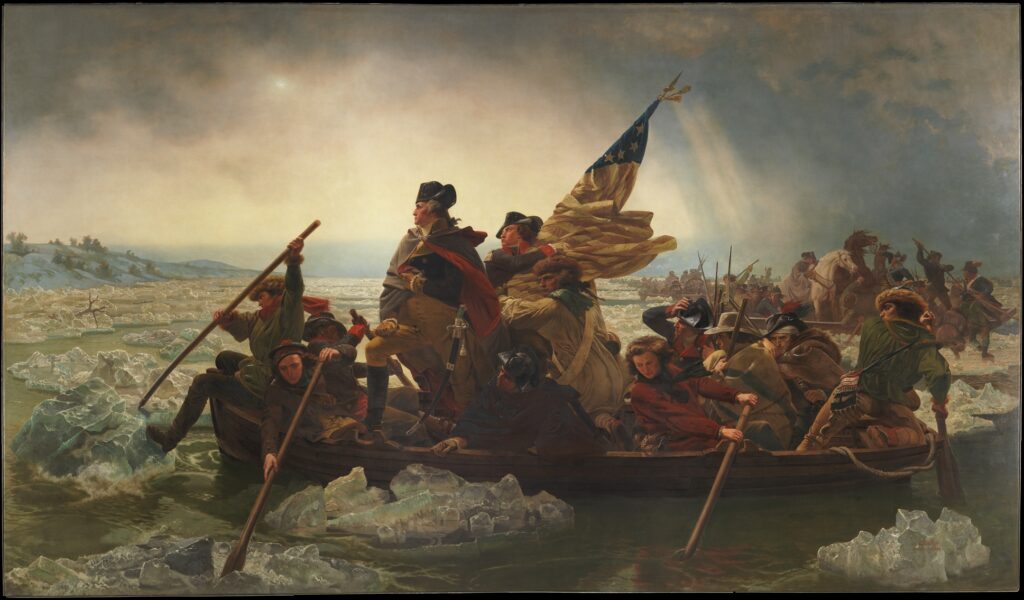
The Trenton-Princeton campaign in the winter of 1776 marked a turning point in the struggle for independence. After six months of disasters, in which Washington was driven from New York City and across New Jersey into Pennsylvania, he managed to return over the Delaware River and hand his pursuers two small but stinging defeats, which ended Britain’s hopes of wrapping up the war quickly. With his signature literary flourish, Mason Locke Weems, Washington’s first biographer, made the army’s nighttime passage of the river the perilous symbol of the entire operation:
Washington and his little forlorn hope, pressed on through the darksome night, pelted by an incessant storm of hail and snow. On approaching the river, nine miles above Trenton, they heard the unwelcome roar of ice, loud crashing along the angry flood. . . . The troops were instantly embarked, and after five hours of infinite toil and danger, landed, some of them frost-bitten.10
Leutze painted two large copies of the scene. The first would be destroyed in an air raid on Bremen in World War II; the second was shipped to New York in 1851, where 50,000 people saw it, including an eight-year-old Henry James. “We gaped responsive to every item,” he remembered, “lost in the marvel of the wintry light, of the sharpness of the ice-blocks.”11
Leutze created a hyperreal image of a little American armada, crossing the Delaware from right to left. The canvas is dominated by the lead boat, in which Washington stands, gazing literally at New Jersey, symbolically at the future. The American flag next to him is borne by 18-year-old Lieutenant James Monroe. The clothing of the figures in the boat shows that they are Americans of different regions and classes: Virginia gentlemen, Philadelphia merchants, New England sailors, frontier riflemen. As David Hackett Fischer explained in his book Washington’s Crossing, they are all in the same boat.
The long hair of the red-jacketed oarsman on the port side has led some to suppose that he is in fact a she. During the Revolutionary War, a handful of women slipped into the ranks dressed as men. Women of the army served officially as nurses and cooks and sometimes fought, the most famous being Mary Ludwig Hays, better known as Molly Pitcher, who swabbed her husband’s cannon at the Battle of Monmouth.
The identification of a woman here is probably fanciful. Not fanciful is the black oarsman near the starboard bow. The regiment that manned the boats on the night of the crossing was the 14th Massachusetts, composed of sailors from Marblehead, including blacks and Native Americans. (Readers of Moby-Dick will know about the diversity of ships’ crews.) The 14th Massachusetts were not immigrants, but they got the job done.12
Washington Crossing the Delaware ended up in the collection of the Metropolitan Museum of Art in New York. It is a huge canvas, about 21 feet by 12 feet. In the 21st century it was given an elaborate carved gilt frame, matching the one it had when first shown. Since the painting is too large to be carried out the door of the room in which it hangs, the work of reframing had to be done on the spot. The painting regularly makes lists of the most famous and must-see works in the Met’s collections.13
John Trumbull, born in 1756, was a veteran of the American Revolution who served briefly on the staffs of Washington and Horatio Gates. His father, Jonathan Trumbull Sr., was governor of Connecticut, which allowed John to meet everyone who counted. He went to London to study painting with the American-born Benjamin West and absorbed the innovations in history painting that West and another American émigré, John Singleton Copley, were making. Sir Joshua Reynolds, the greatest British painter of the day, thought figures in contemporary history paintings should be portrayed in classical, or at least timeless, garments so as not to distract from their actions and characters. West and Copley went the other way, loading their canvases with details of weapons, uniforms, and other accoutrements.
Trumbull envisioned an innovation of his own: He would not confine himself to portraits of great contemporaries or scenes of single events but would execute a series of paintings that told the history of the American Revolution. It took him over 45 years of a long and often distracted life, but by 1832 he finished eight paintings, which he donated to Yale College.
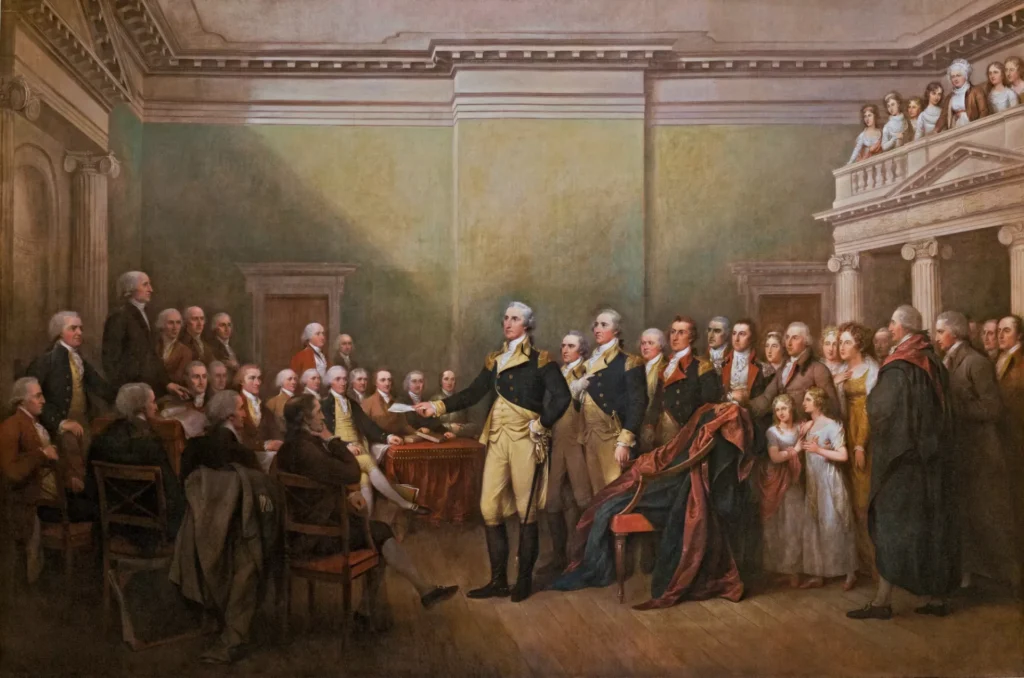
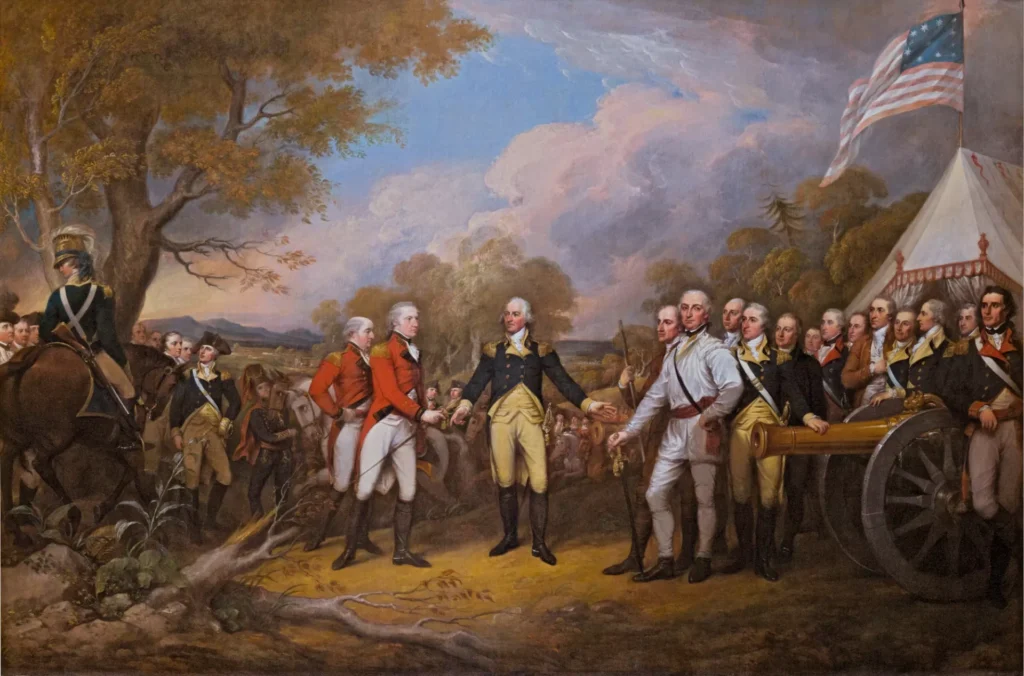
Trumbull was proud of his military career. In a midlife self-portrait he showed himself sitting near his palette but holding his sword, as though his service was more important to him than his talent was. His series is tilted toward the military: Three paintings show battles (Bunker Hill, Quebec, and Princeton) and three surrenders (Trenton, Saratoga, and Yorktown), while one, General George Washington Resigning His Commission, shows a scene in Congress, half populated by men in uniform (Washington, come to give his commission up, and the comrades who have accompanied him).
One painting is entirely civilian: Declaration of Independence. This is the painter’s vision of what Stone and Edwards put onstage. Trumbull got the idea from Jefferson himself, when Jefferson was minister to France in the late 1780s and Trumbull, studying art in Paris, was his houseguest. Jefferson made a drawing of the floor plan of the room in which the Continental Congress had met; on the bottom of the paper, Trumbull made his first sketch of the scene.
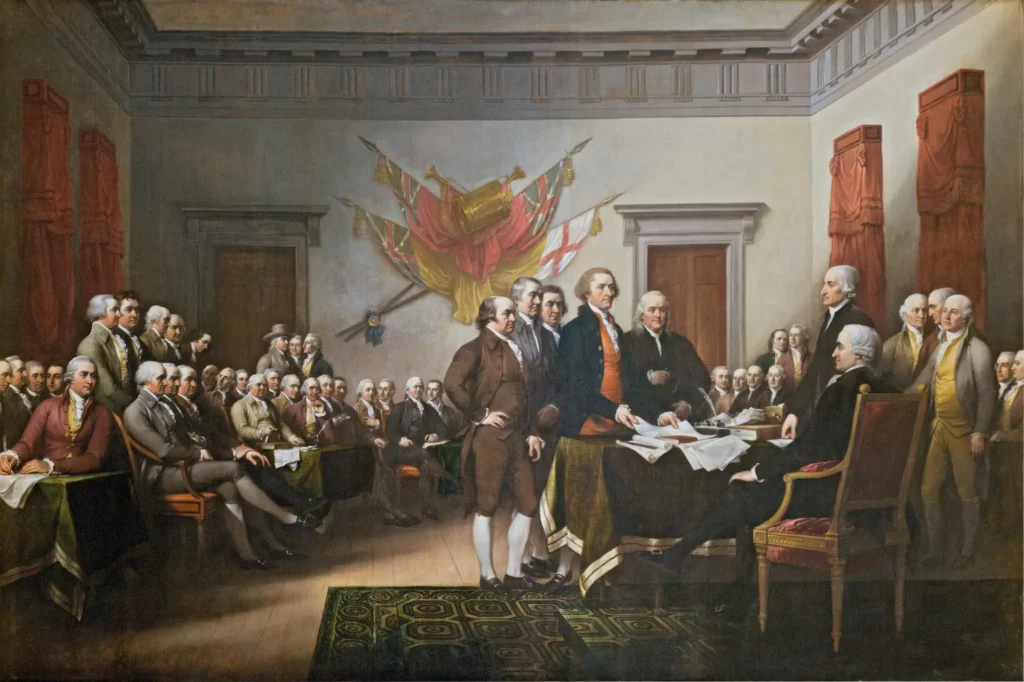
Trumbull shows the five members of the drafting committee—Adams, Roger Sherman, Robert Livingston, Jefferson, and Franklin—presenting their handiwork to John Hancock, the president of the Continental Congress. Behind and around them the other delegates to Congress spread out, sitting or standing. Jefferson is the tallest man in the room and the brightest—Trumbull has put him in a red waistcoat. Adams stands in the dead center of the composition. Franklin is the only man in it looking directly at us. A few of the delegates are talking among themselves, but the great majority and we, the viewers, are paying attention to what the drafting committee is offering.
We cannot see any of Jefferson’s words on the piece of paper that Hancock is receiving, yet the painting, mute though it is, tells us important things about the nation the delegates were expecting to make. There is a war going on, as captured enemy flags and drums hanging as trophies on the back wall of the room remind us. But every man here is in ordinary civilian dress. This is not a revolution of generals, as Haiti’s and Latin America’s will be or France’s will become.
The clothing also shows us that these men are broadly similar. A few are enormously wealthy—when Charles Carroll of Maryland signed, someone purportedly cracked, “There go a few millions”—others merely prosperous.14 None are noble; there are no coronets, ermines, or chains of rank. Aristocratic orders have gone by the wayside.
These men, finally, have deliberated; they are behaving deliberately now. There are no impassioned salutes. Trumbull saw the stiff-armed Romans of Jacques-Louis David’s 1784 Oath of the Horatii in David’s studio in Paris; their gestures would be repeated in David’s sketch of Tennis Court Oath at the dawn of the French Revolution. But America’s revolutionaries swore too: The Declaration’s signers pledged lives, fortunes, and sacred honor. Four would be captured during the war, and one would have to hide in a cave; thousands of the soldiers they sent into combat would die. But as they fought—as the fighting went on—they thought, discussed, and decided.
Trumbull painted his Declaration in 1787. The original three-foot-by-two-foot canvas hangs at Yale. A larger, half-life-sized copy hangs with four other enlarged paintings from his revolutionary series at the Wadsworth Atheneum Museum of Art in Hartford. But the one that millions of people see is the life-sized copy displayed with three of its fellows (Surrender of General Burgoyne, Surrender of Lord Cornwallis, and General George Washington Resigning His Commission) in the Capitol Rotunda in Washington, DC.
Trumbull’s Declaration is reproduced in textbooks, in history books, and on the reverse of the two-dollar bill. It is the necessary pendant to Trumbull’s and Leutze’s and everyone else’s battle scenes. It shows what the Revolution was fought for. Ideas sometimes have to be secured by combat before they can become real in the world—a lesson for thinkers. Wars have to be guided by ideas or they become scrambles for dominance—a lesson for warriors.
Not all who see the Declaration or Trumbull’s other paintings understand them. On January 6, 2021, one of the protesters who invaded the Capitol was photographed toting the Speaker of the House’s lectern across the Rotunda with Surrender of General Burgoyne in the background. There were riots and worse before and during the Revolution; they are the static of all revolutions, when they are not the main current. But they were not what Trumbull painted or what his subjects led or expected to use in governing. Most viewers will get the message; Trumbull made it as plain as he could.
The Revolution Lives On
A shelf of books, two musicals, two paintings—that is not a bad account of the American Revolution to start. It grabs the attention; on further reading, listening, or viewing, it reveals deeper meanings.
A lot in our lives competes with even great events of the past, let alone all the other events past, current, and to come: work, fun and games, and the backward pull of time. But we still live with the country and the institutions the revolutionaries made. It is worth a little trouble understanding them. Many Americans through the years have taken that trouble, and many still do.
