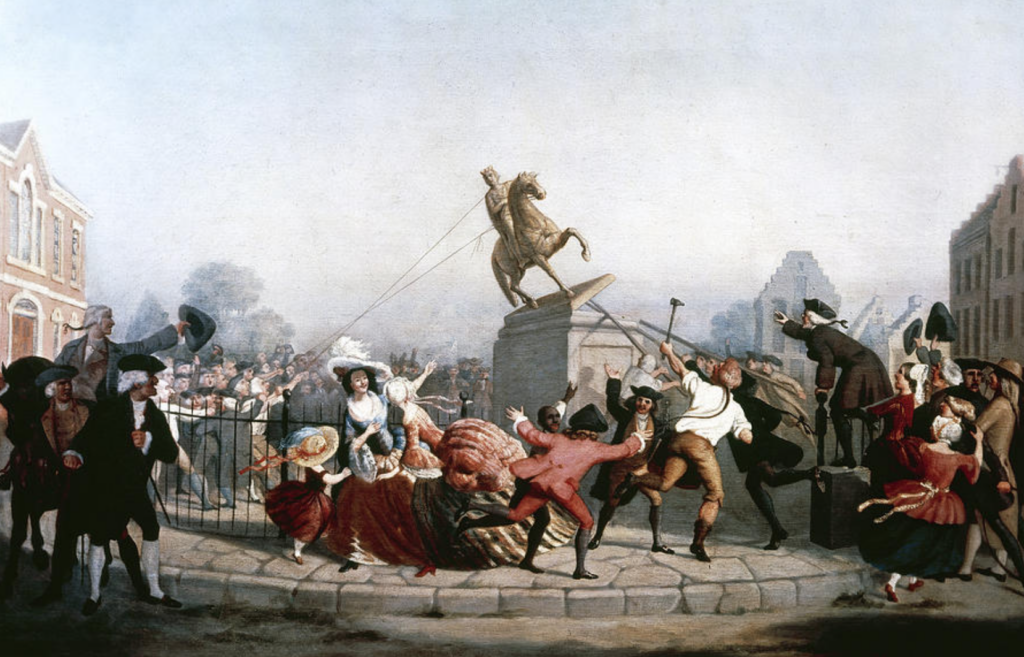

July 4, 2026, will mark the 250th anniversary of the Declaration of Independence and, therefore, of the United States of America. In wondering how to properly observe and celebrate that event, Americans today are following in the footsteps of every generation since the American founding itself. The question of how we remember the American Revolution has always been a focal point for political debate and civic friction. But the celebration of our common inheritance also has always had the power to bring Americans together.
As we mark this seminal year, therefore, we can look to prior moments of patriotic celebration and reflection for guidance. The way the Revolution has been understood at different moments in our history is itself a crucial part of the Revolution’s legacy. What the struggle for independence has meant to Americans in the past ought to be part of how we determine what it should mean to us now.
Key to what we learn when we consider the Revolution’s place in the historical self-understandings of different generations of Americans is that the founding has always been used as a lens through which to view the present. In the lead-up to the Civil War, the Declaration of Independence was at the core of the debate over slavery, and Abraham Lincoln in particular made it his touchstone. Later in the 19th century, the Revolution came to be seen as the root of the risk-taking, venturesome spirit of both the Western frontier and the industrializing economy. In debates over the role of government in the first half of the 20th century, advocates of energetic centralized administration revived Alexander Hamilton’s thought, while those who sought limits on federal power cited Thomas Jefferson instead. And during the Cold War, both capitalism and freedom were presented as direct extensions of the principles of the founding, while the movement for equal civil rights for black Americans emphasized the Declaration’s commitment to the equality of all.
That pattern of appropriating the founding for contemporary political ends certainly continues in our time. Our debates about such divisive issues as executive power, social equality, immigration and national identity, and more call on the heroes and ideals of the American Revolution. Partisans of all sorts see the potential to advance their causes in a year when Americans’ attention is once again directed to our nation’s origins.
But even as these arguments of the moment look to the moral vocabulary of the Revolution for support, some of the founding’s fundamental tenets continue to insist on their own distinct and timeless relevance. This, too, has long been evident to Americans with a historical perspective. As the nation celebrated the 150th anniversary of the founding in 1926, President Calvin Coolidge took note of that timelessness in remarks at Independence Hall in Philadelphia:
It is often asserted that the world has made a great deal of progress since 1776, that we have had new thoughts and new experiences which have given us a great advance over the people of that day, and that we may therefore very well discard their conclusions for something more modern. But that reasoning can not be applied to this great charter. If all men are created equal, that is final. If they are endowed with inalienable rights, that is final. If governments derive their just powers from the consent of the governed, that is final. No advance, no progress can be made beyond these propositions. If anyone wishes to deny their truth or their soundness, the only direction in which he can proceed historically is not forward, but backward toward the time when there was no equality, no rights of the individual, no rule of the people. Those who wish to proceed in that direction can not lay claim to progress. They are reactionary. Their ideas are not more modern, but more ancient, than those of the Revolutionary fathers.1
The finality that defines the Declaration’s fundamental arguments is why they stand as durable standards for American life and why Americans in very different times and circumstances have appealed to them. Understanding the Declaration and the memory of the Revolution is therefore essential to better understanding America.
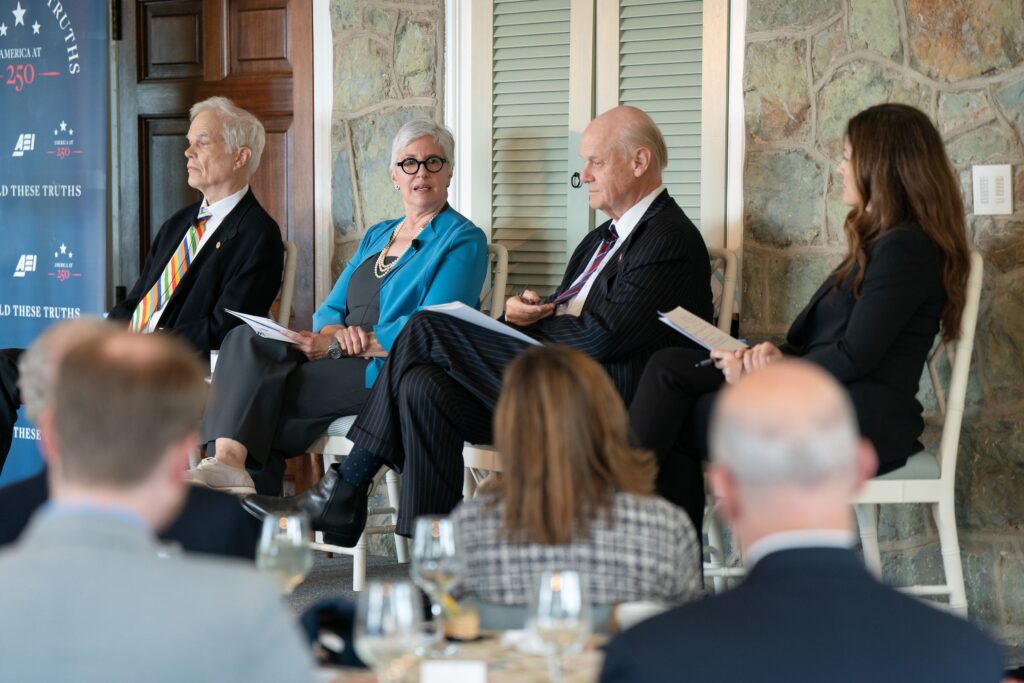
Better understanding America is precisely the purpose of the American Enterprise Institute’s “We Hold These Truths: America at 250” initiative, an ambitious celebration of the founding of which this volume forms a part. Over several years leading up to the anniversary of the Declaration of Independence, we have invited scholars both within AEI and from other institutions to take up a series of themes important to understanding the American Revolution. These scholars represent a variety of fields and viewpoints, so they approach each of these themes from various angles. The papers they have produced have been published in a series of edited volumes intended to help Americans think more deeply and clearly about our nation’s origins, character, and prospects.
The American Revolution in American History is the eighth and final of those books. Its chapters began as papers presented at an AEI conference held at Thomas Jefferson’s Monticello on September 3, 2025. Other volumes in the series consider the American Revolution in relation to other themes, such as democracy, religion, natural rights, and global affairs. In each case, our goal is to help reintroduce readers to their nation’s history, thereby enabling them to maturely appreciate the reasons for celebrating the extraordinary milestone of its 250th anniversary.
In the chapters that follow, five eminent scholars of history and government consider the ways in which the American Revolution has been interpreted in different periods of our history.
Richard Brookhiser traces how the story of the founding has been told in popular culture—particularly in works of popular history, drama, and art—and finds a great deal to appreciate.
Jane Kamensky examines the depiction of the American Revolution in film and considers why the high drama of the War of Independence has never been properly translated into a good movie.
Allen C. Guelzo looks at how Americans in the first hundred years of our national life used and misused the Revolution and what lessons we who are much further from those great events might draw from earlier interpreters.
Rita Koganzon assesses the changing ways in which American textbooks have taught the Revolution over the past 250 years, finding that the legacy of 1776 has been presented to students variously as sets of exemplars to emulate, systems to manage, and structures to resist.
Wilfred McClay argues that Americans have always fought about the meaning of the American Revolution but for that very reason have always also found in it much inspiration for a shared love of country.
All of these arguments suggest that history can never fully stand apart from its subjects. That is surely true of the very project of which this volume forms the final installment. We have sought not just to shine a light on the people, events, and ideas that defined the founding era but to invite readers to reflect on what their struggles and achievements illuminate about our own time—and the American future we all will build in common.