July 4, 2026, will mark the 250th anniversary of the Declaration of Independence and, therefore, of the United States of America. In celebrating that milestone, Americans will naturally incline to highlight what is distinct about us and what separates us from other nations of the world. And yet the American founding cannot be understood apart from the international context in which it occurred and the international order that it transformed.
The founders were keenly aware that the world was watching them. The very first sentence of the Declaration of Independence sets the scene in global terms:
When in the Course of human events, it becomes necessary for one people to dissolve the political bands which have connected them with another, and to assume among the powers of the earth, the separate and equal station to which the Laws of Nature and of Nature’s God entitle them, a decent respect to the opinions of mankind requires that they should declare the causes which impel them to the separation.
The case the Declaration makes for revolution then rests on a set of grievances that are presented as facts to be submitted “to a candid world.” And in the end, the Declaration asserts that the goal of the American Revolution is to establish
that these United Colonies are, and of Right ought to be Free and Independent States; that they are Absolved from all Allegiance to the British Crown, and that all political connection between them and the State of Great Britain, is and ought to be totally dissolved; and that as Free and Independent States, they have full Power to levy War, conclude Peace, contract Alliances, establish Commerce, and to do all other Acts and Things which Independent States may of right do.
That founding generation of Americans, in other words, fought to establish America’s place among the nations. And they knew that they could succeed only if they played their part in the great game of the European powers. The founding also established some basic patterns of American foreign policy that endured for many decades and that, in some respects, continue even now to shape our country’s sense of its place in global politics. It is not possible to understand our country, its history, and its character without a sense of how the Revolution became an event of international significance.
Better understanding our country is precisely the purpose of the American Enterprise Institute’s “We Hold These Truths: America at 250” initiative, an ambitious celebration of the founding of which this volume forms a part. Over several years leading up to the anniversary of the Declaration of Independence, we are inviting scholars both within AEI and from other institutions to take up a series of themes important to understanding the American Revolution. These scholars represent a variety of fields and viewpoints, so they will approach each of these themes from various angles. The papers they produce will be published in a series of edited volumes intended to help Americans think more deeply and clearly about our nation’s origins, character, and prospects.
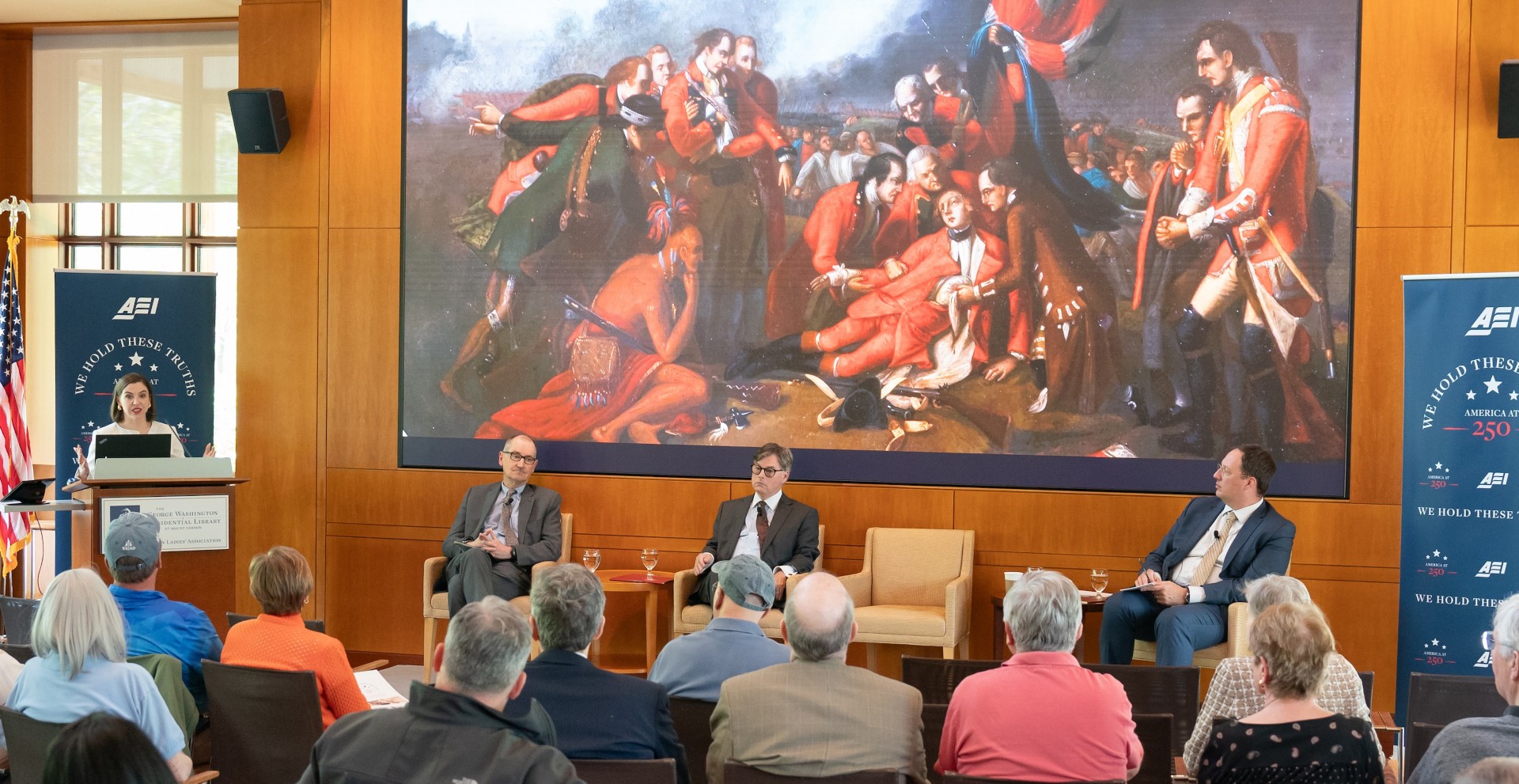
The American Revolution and America’s Role in the World is the sixth of those books. Its chapters began as papers presented at an AEI conference held at the George Washington Presidential Library at Mount Vernon on April 24, 2025. Other volumes in the series consider the American Revolution in relation to other themes, such as democracy, religion, natural rights, and the Constitution. In each case, our goal is to help reintroduce readers to their nation’s history, thereby enabling them to maturely appreciate the reasons for celebrating the extraordinary milestone of its 250th anniversary.
In the chapters that follow, six eminent scholars of history, law, and government consider how we ought to understand the American Revolution as a global event and how it changed the international order.
William Anthony Hay examines some of the global precedents that inspired the Revolution and its leaders. He considers what was new and unique about the founding and what was an extension of deep and ingrained patterns of European politics.
Jeremy Rabkin traces the commitment of the founding generation to the law of nations and how the founders understood the rules of the international order in relation to the principles that shaped American political thought.
Gary J. Schmitt highlights the principles of statesmanship implicit in the Declaration of Independence and shows how different generations of American leaders adopted and adapted these as the United States gradually evolved into a global superpower.
Lindsay M. Chervinsky illuminates how international questions shaped the American independence movement and the politics of the early republic and traces the origins of American foreign policy.
Eliga H. Gould considers why America’s first generation of statesmen sought to keep the new nation out of Europe’s wars and how these efforts shaped two centuries and more of American diplomacy.
Walter Russell Mead shows just how central foreign policy concerns were to the architects of the American constitutional system and what lessons their thought might offer to leaders struggling to shape a 21st-century foreign policy for our country.
All of these arguments suggest that the United States has never been an insular or isolation-minded nation. From its earliest days, our society has understood that its prospects in a dangerous world depended on responsibly playing its part in global affairs—and assuming its separate and equal station among the powers of the earth.